How to Measure Your Pupillary Distance
What is PD?
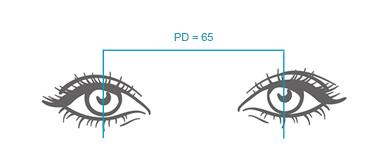
Pupillary Distance (PD) refers to the measurement between the centers of your pupils. This metric is crucial as it dictates the optimal viewing point through your spectacle lenses, and its accuracy is paramount, particularly for individuals with strong prescriptions. Typically, your PD value can be found on your eyeglasses prescription. Generally, adult PD measurements remain consistent. For men, the average PD is approximately 64mm, while for women, it's around 62mm. Children's PD values usually range from about 43 to 58mm.
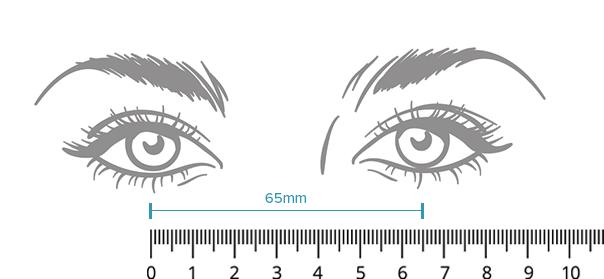
What does PD mean for glasses:
1. Binocular PD: This is often shown as a single number (e.g., "63"), representing the total distance between the centers of both pupils.
2. Monocular PD: This measurement indicates the distance from the bridge of your nose to each pupil separately. It's typically given as two numbers, each around 30mm (e.g., "31" and "32").
3. Split PD (Distance/Reading): Occasionally, you might see PD notated like "61/58". Here, "61" is your distance PD, suitable for single-vision distance, bifocal, or progressive lenses. The "58" is your reading PD, used exclusively for single-vision reading glasses. It's worth noting that reading PD is generally about 3mm less than distance PD, as our eyes naturally converge when focusing up close.
It's common for an eye exam prescription not to include your PD. If yours is missing, there's no need to be concerned; we have ways to assist you.
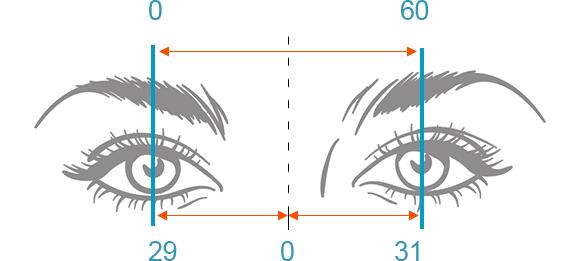
How to measure PD and PD checker
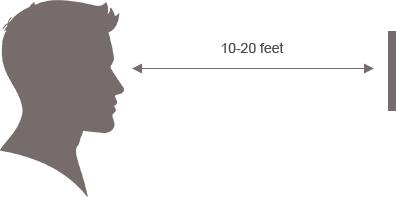
You can easily measure your PD right at home, and it's even simpler if you have a friend or family member to help out. To get started, take off any glasses you might be wearing. Then, fix your gaze on an object that's roughly 10 to 20 feet away.
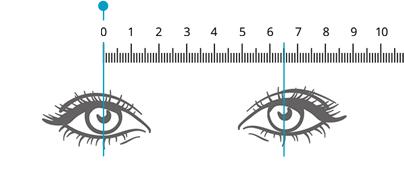
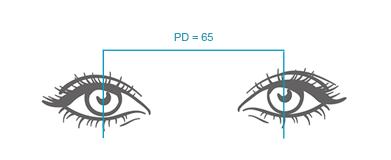
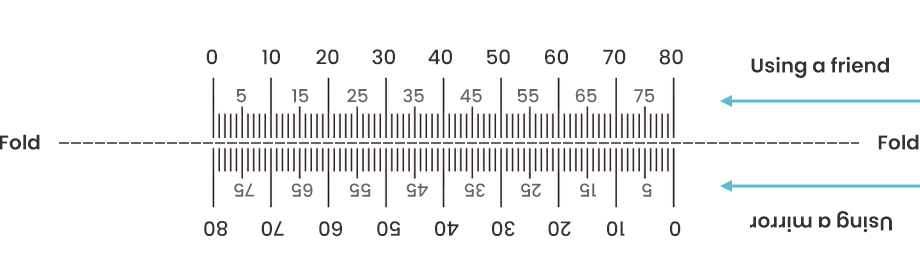
Have your friend position a PD ruler across your eyes, aligning the "zero" mark with the center of your right pupil. Your friend should then read the number that sits directly over the center of your left pupil – this is your PD. To ensure accuracy, ask your friend to repeat this measurement a few times.
PD measurement by the PD tools?
Measuring your PD is also simple to do on your own. All you'll need are your PD ruler and a mirror.
1. Take your PD ruler and fold it so that the side marked "using a mirror" is visible.
2. Stand roughly 8 inches (or 20 cm) in front of a mirror.
3. Hold the ruler up to your eyes, aligning the "zero" mark directly over your left pupil.
4. Close your left eye, then open your right eye while maintaining a straight gaze. The number that now sits precisely over your right pupil is your PD.
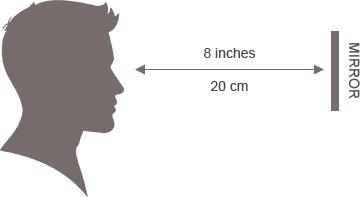
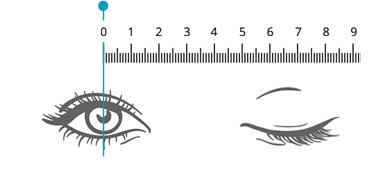
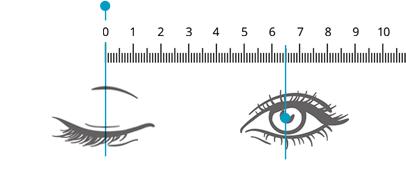
Remember: If you're purchasing reading glasses, subtract 3mm from your measured PD.
For further details, please refer to our available guides.
Printable PD ruler
Ensure the PD ruler is printed at its actual size (100%). Avoid using "scaling" or "fit to page" options in your print settings.
To confirm accuracy, verify the printout against a standard millimeter ruler.
FAQ
What does the PD number mean for glasses?
Pupillary Distance (PD), measured in millimeters, quantifies the span between the centers of your pupils. This measurement is fundamental for crafting eyeglasses, as it guarantees the precise alignment of each lens's optical center with your pupils. Accurate PD is vital for ensuring optimal clarity and comfort in your vision correction. While the average adult PD is approximately 60mm, slight gender-based differences exist. Men typically have an average PD of about 64mm, whereas for women, it's around 62mm. Nevertheless, individual PD can differ significantly, necessitating precise measurement for the most effective vision correction.
Can I measure my PD with my phone?
Indeed, you can complete your PD measurement digitally using specific mobile applications, such as EyeMeasure. These apps leverage your phone's camera to precisely determine the distance between your pupils. However, it is crucial to select a trustworthy application and adhere closely to its instructions to obtain an accurate result. As an alternative, a traditional method involving a ruler and mirror can also be used to measure your PD at home.
Why is my PD not on my prescription?
Several factors might explain why your pupillary distance (PD) isn't listed on your prescription. Some eye care professionals don't habitually include PD, particularly if you've obtained eyewear from various sources. Furthermore, PD measurements can differ based on whether you're focusing on distant or near objects, which might lead your eye care provider to prefer taking that measurement themselves. If your prescription lacks your PD, you can either request your eye care professional to measure it for you or opt to measure it at home using a ruler and a mirror.
What if PD is off by 2mm?
Typically, a minor discrepancy of 2mm in your Pupillary Distance (PD) measurement won't significantly impact most individuals. Nevertheless, achieving a more precise measurement can enhance both the visual correction and comfort provided by your eyeglasses. Should you notice a PD error of 2mm or greater, it's prudent to consult an eye care professional for a more exact measurement. They can also make necessary adjustments to your glasses to ensure proper alignment with your eyes.
For any further assistance or questions, please don't hesitate to reach out to us at [email protected]